
Growth for FQHCs: Plan Early, Fund Smart, Spend Wisely
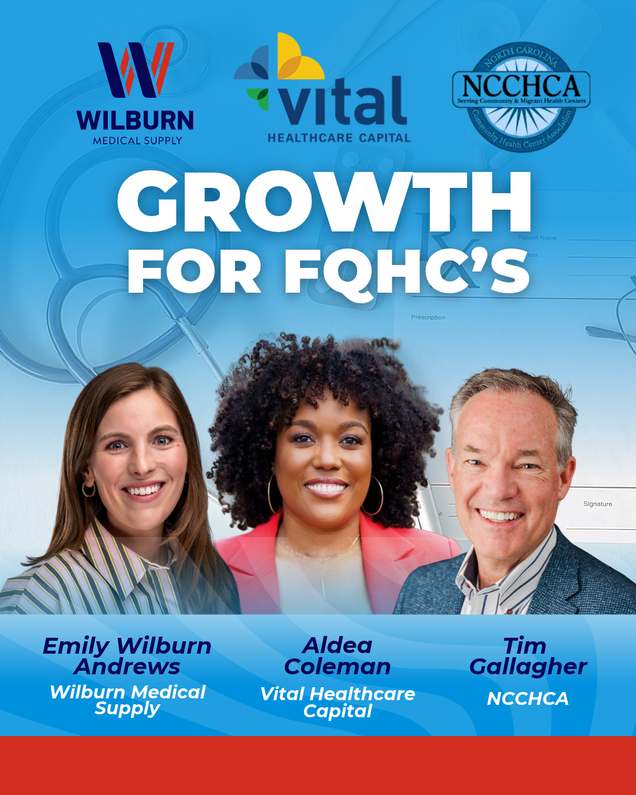
Recently, we spent a lunch hour with health center leaders from the mountains to the coast. We were joined by Aldea Coleman of Vital Healthcare Capital (V-Cap) and Tim Gallagher of the North Carolina Community Health Center Association (NCCHCA) for a conversation about how FQHCs can grow with confidence. Here’s what stood out.
Financing growth with New Markets Tax Credits
Aldea Coleman, Director of Partnerships and Advocacy at V-Cap, explained that V-Cap is a national CDFI that sees itself as more than a lender. Through its technical assistance program, VitalTA, consultants help health centers with business planning, patient acquisition, payer mix optimization, and capital project planning before financing enters the picture.
One of the most powerful tools she covered is the New Markets Tax Credit, which can translate into a net subsidy of roughly 15-20% of total project cost. North Carolina health centers have been underrepresented in this type of financing. V-Cap and NCCHCA have formed a new partnership with a 3-year goal of making $35-40 million in subsidy available to NC health centers, along with targeted technical assistance and help leveraging philanthropic funds.
What V-Cap is offering NC health centers in 2026
- VitalTA technical assistance funding: $25,000-$100,000 for NC FQHCs
- New Markets Tax Credit financing and support: $2-4 million of subsidy for FQHC capital projects
- Loans for FQHC expansion: $500K to $25M, with rates and terms targeted to health center needs
Aldea’s advice: talk to V-Cap early about planned or potential capital projects.
What it looks like in practice: MedNorth Health Center
MedNorth in Wilmington started with a needs assessment and business plan through VitalTA. That work helped leadership decide to add a new building on their site and keep the original for administration, rather than tearing it down. The result is a $23 million project with primary care on the first floor and dental on the second. Aldea’s advice for anyone considering a similar path: talk early, because your board needs time to understand the financing as well.
MedNorth CEO Althea Johnson put it this way: “V-Cap’s support in navigating New Market Tax Credits and providing technical assistance funding has been highly valued throughout our health center’s growth.”
Managing growth as a funnel
Tim Gallagher, Head of Business Growth and Strategy at NCCHCA, encouraged health centers to treat growth as a sequenced process rather than a reaction. Moving from technical assistance to a strategic plan, a building committee, and finally a ribbon cutting takes time, and low-cost capital works best when partners are engaged early and aligned with your existing plans.
He also gave an update on the Rural Health Transformation Program. Much of the funding will flow through six regional ROOTS hubs, with dollars coming in through October 2030, and the hub structure allows community health centers to take leadership and delivery roles. Some initiatives, including Initiatives 3 and 6, do not flow through the hubs. The specifics of how organizations will be able to respond are still being worked out, and Tim noted that tracking this is a full-time job for him right now. His request to health centers was simple: share your plans so NCCHCA can help find funding sources to match them.
Stretching every supply dollar
Our CEO, Emily Wilburn Andrews, grounded the conversation in the numbers. Cost per patient has risen 37% since 2021 and now averages $1,672, across 32.7 million patients served in 2025 and $54.7 billion in total health center costs (HRSA 2025 UDS data). Every dollar saved on supplies and equipment can be redirected toward the mission.
Emily framed it as eight places you might be leaving money on the table, whichever distributor you use: contract and GPO pricing, SKU consolidation, freight optimization, private-label opportunities, manufacturer rebates, equivalent product conversions, utilization review, and basket-level analysis. Her point: it isn’t about finding the cheapest box, it’s about lowering your total cost of care.
The same thinking applies to new builds and remodels. On an illustrative $1 million equipment and build-out budget, potential cost avoidance is $50,000 at 5%, $100,000 at 10%, and $150,000 at 15%. Planning early, standardizing rooms, value engineering, leveraging contracts, and coordinating vendors can all help, and savings can start long before the purchase order. Actual project savings vary by scope, specifications, and purchasing agreements.
Real results
When we analyzed supply lists for 5 CHCs, we beat their price on 93% of items. In one sample analysis, we found over $77,000 in savings. And at United Health Centers, we helped outfit a $4 million+ facility with 8 medical rooms, a full dental suite, a pharmacy, a lab, and phlebotomy, with live design sessions along the way.
Next steps
- Watch the full recording: https://youtu.be/cZbPHQvPHKM
- Learn about VitalTA and New Markets Tax Credits: contact Aldea Coleman at acoleman@vitalcap.org
- Share your growth plans with NCCHCA: contact Tim Gallagher at [TIM’S CONTACT]
- Request a no-obligation supply analysis or talk about a build-out: call or email Emily and Ashley Ellington at 1-877-WILBURN (945-2876) or wusainfo@wilburnmedical.com
Recent Posts
-

Growth for FQHCs: Plan Early, Fund Smart, Spend Wisely
Recently, we spent a lunch hour with health center leaders from the mountains to the coast. We were …Oct 08, 2026 -

2026 CHC Hero Award Winners
CHC Hero Award — 2026 Winner Announcement We're so glad to finally share this. Meet our 2026 CH …Aug 19, 2026 -
10 AED Winners to Celebrate 10 Years
Today we take a moment to share this reflection from our CEO, Emily Wilburn Andrews, on the moment …Jun 23, 2026